

Zapier review
Choose Zapier when breadth and speed matter more than infrastructure control.
Small teams that prioritize app coverage and a short learning curve.
Strengths
- Large integration catalog
- Fast setup for linear workflows
- Mature templates and administration
Watchouts
- Complex branching can become hard to audit
- High-volume task economics need modeling
- Partner program is not a general public affiliate offer
Operating fit
Task-based billing can become difficult to forecast as multi-step workflows grow.
Check your fitInspect the operating surface
This official interface reference is included to help plan a representative trial. Product interfaces can change.
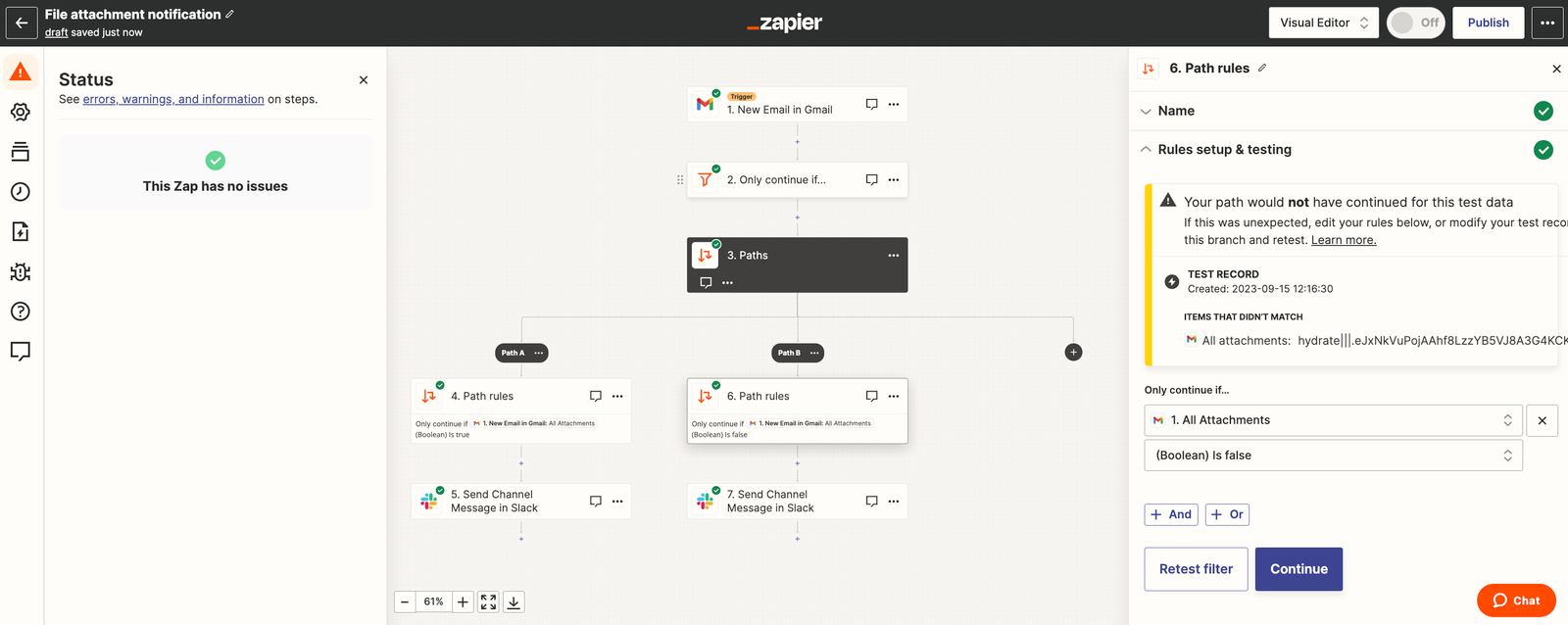
What Zapier is designed to do
Zapier sits in the broad no-code automation category. Its practical value depends on how closely your process matches that model. A team should validate the exact trigger, connector permissions, record ownership, branching behavior, retry policy, and export path before treating a successful demo as production-ready.
Setup and maintenance
Build a pilot around one stable workflow and use test records that can be removed. Document who owns credentials, who receives failure alerts, and what happens when the destination API is unavailable. Track correction time as part of operating cost. A low-code interface does not remove the need for process ownership.
Task-based billing can become difficult to forecast as multi-step workflows grow.
A representative pilot for Zapier
Use a form-to-CRM-to-notification flow with one filter and one duplicate submission. Check whether every action consumes a task, how replay works, and which team members can edit credentials.
Failure scenario to test
A linear Zap can appear healthy while a downstream action is paused or rate-limited. Test partial completion, task replay, and the effect of changing a field in the source app.
Migration and exit check
Export a list of active Zaps, owners, connected accounts, triggers, actions, and business purpose. Rebuilding elsewhere usually means recreating logic rather than importing a portable workflow file.
Data control and failure handling
Review what data leaves each system, where logs are retained, and whether sensitive fields can be excluded. Confirm how duplicate events, timeouts, partial writes, and expired credentials appear in the run history. High-consequence actions should use idempotency controls or an approval checkpoint.
Cost questions to answer
Estimate monthly triggers, steps per run, retries, premium connectors, users, AI usage, and review labor. Compare that total with the manual baseline and with the cost of an incorrect action. Use our ROI calculator to make assumptions explicit.
Alternatives worth comparing
Decision evidence, not a universal score
We reviewed Zapier pricing, mapped the product to its stated broad no-code automation operating model, and converted the claims into a representative pilot, failure test, cost questions, and an exit check. We did not access a reader account or infer private plan terms. The score summarizes fit for a defined small-team workflow; it is not a laboratory benchmark or a promise that Zapier will suit every process.
Before choosing Zapier, reproduce the pilot with test records and save the trigger, expected output, run history, task or operation count, review time, correction work, required plan, connector ownership, and export result. Ask the future workflow owner to explain a failed run and restore the intended record without help from the person who built the pilot.
Reject or defer the platform when the required connector, permission model, failure visibility, or sustainable operating cost cannot be verified in writing. Recheck the linked provider source before purchase because pricing, limits, and product controls change.